(IN) Her own words
● About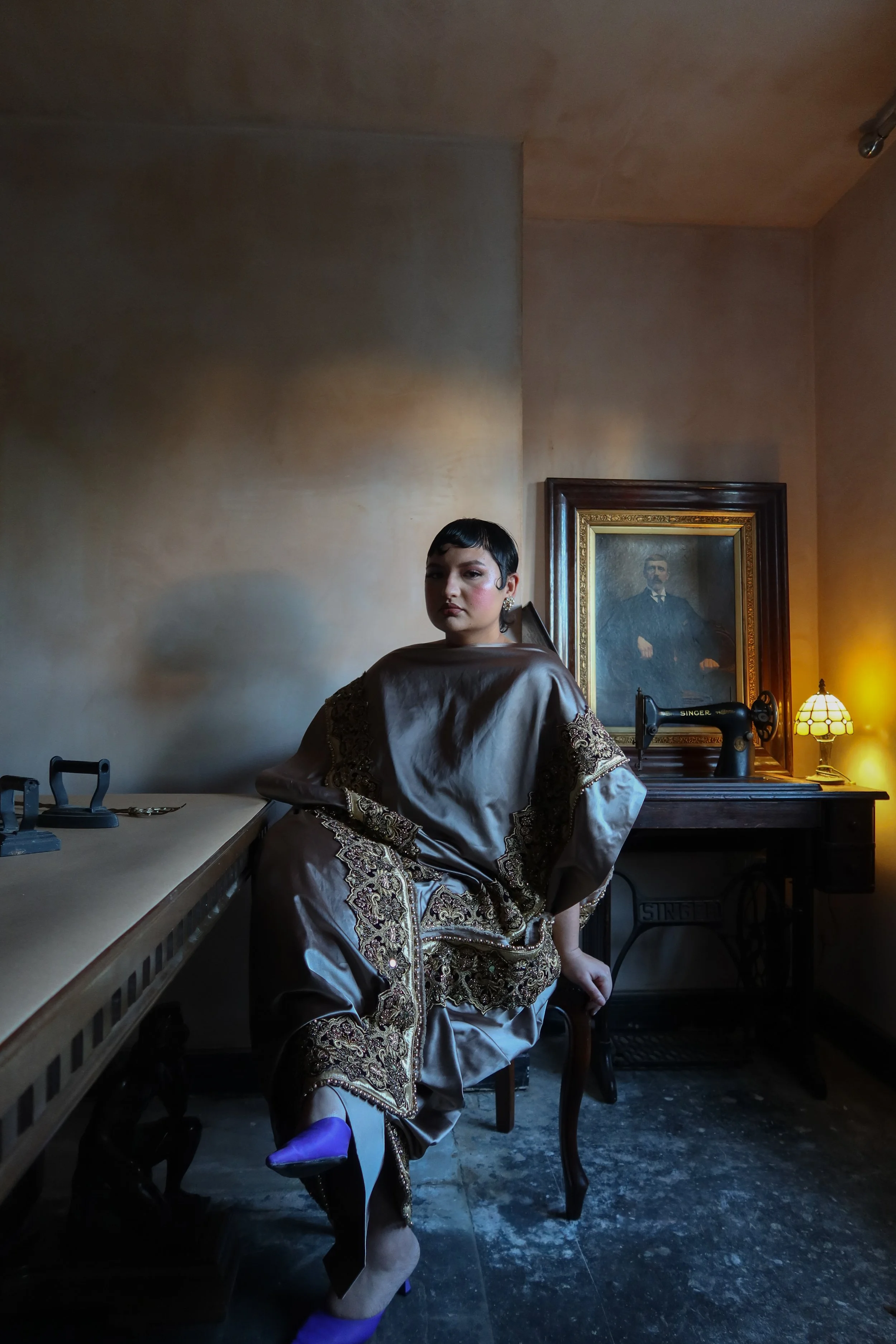
(the) MANIFESTO OF FORTIFIED ABSENCE
The being (i),
the body, the labour, the internal negotiation,
(and)
with its weight, a (sacred void) in (sanctuary).
Here is the (body) : presented (absent) : in a state of (fortification)
separated from (them) (only by) the gravity of what is withheld.
The (other) remain, as (does) the architectural burden of the feminine.
(The Architecture of Resistance) * My practice is an introspective reality where clothing becomes autobiography—forged by the act of being, carrying lived experience, thought and internal negotiation. Across my works, the absent form is an act of defiance. By withholding the physical flesh, I render the silhouette sacred. What is withheld resists transaction and commodification; it can only be gazed up for observation.
(The Ritual of Endurance) * The work is a living record of physical devotion. Through violent precision, I create a second skin—a topography of the internal made external. These pieces are the physical debris of the sacrifice required to exist. By building these habitable structures, I surrender the softness of the interior into a fortified, sculptural entity. The architectural nature of the work represents a refusal to be light; it is the gravity of the self made visible, the true architectural burden of the feminine.
(The Permanent Trace) * My practice demands a cycle of creation and undoing—a deliberate unpicking of the self. Therefore, the archive is not a passive collection; it is the final, essential form of the work. The stills, the frames, and the book are the fixed points in a life of constant shedding. By recording the disappearance of the garment, I document its loss, and ensure that the experience remains even when the structure is returned to nothing.
(The Implicated Void) * My work explores the unstable boundary between observer and subject. It asks the viewer: What are you projecting into this void? The garments implicate the audience in the act of looking, making them conscious of social dynamics and power. Dress becomes both medium and method. The body is treated as an art object, alive in absence. These forms inhabit a temporal, contemplative space—removed from cycles of consumption. They invite reflection, not ownership.
What am (i) without proof?